My 1st Implant training
My 1st Implant - Real Patient
Highlights
3 Days Training (less than 5 hours from UK)
Real Patient
Treatment Planning
Understand Surgical and Prosthetic workflows
Understand CBCT Scan
Place 1st Implant on Patient
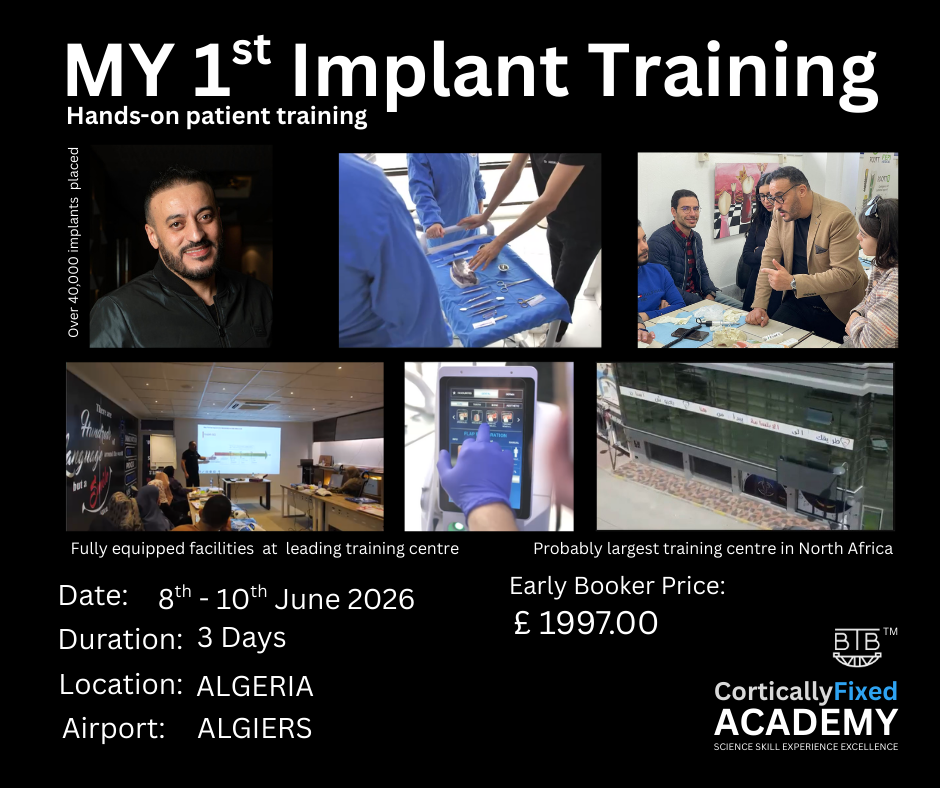
My 1st Dental Implant Training - Real Patient
led by Dr Babouche & experts delivered in English
My 1st Dental Implant Training program is designed to give Practitioners their 1st experience of placing an implant on a real patient on this 3 day training programme.
This is a high intensity training programme to take you from zero to 1st implant placement, from treatment planning to understanding CBCTs to your 1st dental implant placement on a patient.
High Impact, high involvement and highly competitive at our fully equipped modern training centre.
This intensive training combines rigorous theoretical instruction with clinical practice, offering participants a fast-tracked learning experience.
Early Booker Price:
£1,997.00 inclusive
Book before 15th February 2026
includes:
VISA invitation
Accommodation for 3 nights
All Meals
Transfer from Algiers to Setif
Transfers to surgical training centre
All surgical equipment and gowns
Does not include
Flights (average price is £350 return from UK)
Flying time less than 4hours
Why we offer hands-on training outside the UK in our established training centre
- Outside the UK, it is generally easier to recruit patients who are willing to receive treatment as part of a supervised training programme.
- Delivering clinical courses in the UK involves significantly higher operational costs, including staff wages, facility expenses, and regulatory compliance requirements such as CQC registration
- The UK UK has stringent regulations governing patient safety, professional indemnity, and clinical education, including compliance with CQC and GDC standards, which limit the feasibility of intensive hands-on training formats.
- Our overseas programmes allow us to deliver a focused, immersive learning experience through full-day clinical sessions
- This approach is more time-efficient for dentists, particularly busy practitioners, compared with spreading cases over several months in the UK.
- We work with established partner clinics abroad that are fully equipped and experienced in implant procedures and clinical training, ensuring a safe and structured learning environment.
Email us at: info@corticallyfixed.com
My 1st Dental Implant Training led by Dr Babouche & experts
in Algeria (less than 4 hours flying time)
Overseas Course Programme
DAY 1
Module: Foundations of Implant Dentistry
Learning Objective: Learn the foundations of Implant dentistry.
Module: A to Z Dental Implants
Learning Objective:
Apply foundational principles of implant biology to plan implant treatment by performing appropriate case selection and medical risk assessment; conducting clinical, radiographic, and basic CBCT diagnostics; understand suitable flap designs and soft tissue management techniques; following established implant placement protocols to achieve primary stability; identifying and utilizing implant components correctly; understand conventional and digital impression techniques; and recognizing, preventing, and managing common surgical and prosthetic complications within a structured implant workflow.
Format: Lectures, group discussion.
DAY 2
Module: CBCT Interpretation (Hands-on)
Learning Objective: Participants will be able to systematically analyze CBCT scans to identify relevant anatomical structures, assess bone quantity and quality, recognize potential anatomical and pathological risk factors, and apply these findings to support accurate implant case selection, treatment planning, and risk management.
Format: Hands-on, Lectures, group discussion.
DAY 3
Module: Implant Placement
Learning Objective: On day 3 participants will be able to integrate diagnostic findings with surgical principles to safely and predictably perform single-tooth implant placement, including appropriate flap design and soft tissue management, execution of the drilling sequence and implant insertion to achieve primary stability, identification and use of implant components, and recognition and management of common intraoperative complications within established clinical protocols.various implant supported prosthetic options. Evaluate the advantages and limitations of screw-retained and cement-retained restoration.
Format: Hands-on, group feedback.
Email us at: info@corticallyfixed.com